Wisdom from Chinese Literary and Buddhist Classics
365 Days for Travelers
11/15: ALL CAN BECOME BUDDHAS
Venerable Master Hsing Yun (1927 - , Fo Guang Shan)English translation: Fo Guang Shan International Translation Center
Why do we say that taking refuge in the Triple Gem is a manifestation of democracy? The root of this idea resides in the Buddha’s statement, “All sentient beings possess the Buddha Nature; all can become Buddhas.” Everyone is equal in the Buddha Nature; every sentient being is a future Buddha, and all Buddhas were once sentient beings.
Because all sentient beings possess the Intrinsic Triple Gem, taking refuge in the Triple Gem is, in actuality, taking refuge in one’s own Buddha nature, Dharma nature, and Sangha nature. There is an expression that states, “There is no inborn Sakyamuni; there is no natural Maitreya.” One who has great will and can emulate the diligent cultivation efforts of Sakyamuni Buddha and Maitreya Buddha will, indeed, eventually uncover their Buddha Nature. Democracy, in Buddhism, means continuously asserting, “I am the Buddha, I am the Dharma, I am the Sangha.”
This suchness* is as true for us as it is for the Buddha, hence the expression, “There is no difference among the mind, the Buddha, and sentient beings.” The Buddha’s insight into the intrinsic nature of all sentient beings elevated everyone to a level on par with himself. Is this not sufficiently democratic?
All of the world’s religions view their founders as gods and regard the holy as inviolable. But, the Buddha does not position himself above sentient beings; he sees himself as an enlightened sentient being, and sentient beings as unenlightened buddhas. There is no difference between one’s intrinsic nature and the original mind, also referred to as the Buddha mind. As such, to take refuge in the Buddha is to take refuge in one’s own original nature.
── from On Buddhist Democracy, Freedom, and Equality
* Suchness: a term for the true nature of all things; the pure, original
essence of all phenomena, which is called tathata or bhuta-tathata.
What's New?
NOVEMBER

Humble Table, Wise Fare
INSPIRATION
Recorded by Leann Moore
Greed is like an ocean;
anger is like a fire;
ignorance is like the darkness;
self-pride is like a high mountain.

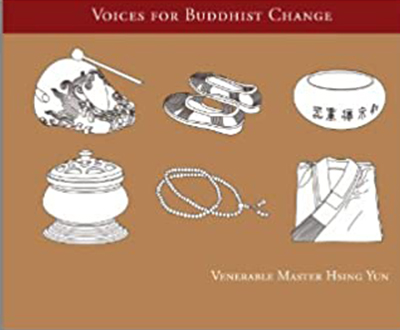
Dharma Instruments
Venerable Master Hsing Yun grants voices to the objects of daily monastic life to tell their stories in this collection of first-person narratives.

Sutra of the Month
The Heart Sutra is a short sutra, commonly chanted individually or in groups, that contains the core teachings on prajnaparamita, or the “perfection of wisdom.” The sutra is short, at only 260 Chinese characters. Included is an English translation of the sutra’s meaning, followed by the Chinese characters and their pronunciation

Newsletter
What is happening at Hsingyun.org this month? Send us your email, and we will make sure you never miss a thing!